
Recently, the Soft Matter and Active Matter Collaborative Research Group, led by Prof. Jie Zhang from the Institute of Natural Sciences and Prof. Matteo Baggioli from the Wilczek Quantum Center of Shanghai Jiao Tong University, has made significant progress in the study of collective dynamics in active matter. Focusing on isotropic active granular systems, the team systematically uncovered collective motion mechanisms in apolar active granular fluids accompanied by topological defects, and for the first time observed turbulent-like inverse energy cascades in this class of systems. These findings provide a new physical picture of how microscopic topological processes drive macroscopic collective behaviors in nonequilibrium active matter.
This work, entitled “Topological signatures of collective dynamics and turbulent-like energy cascades in apolar active granular matter,” has been published in Proceedings of the National Academy of Sciences (PNAS).
Research background
Active matter refers to a broad class of non-equilibrium systems where energy is continuously injected at the level of individual “particles”. These systems exhibit emergent collective behaviors that have no direct thermal-equilibrium counterpart. Their scale ranges from micrometer-sized swarms of bacteria to meter-scale human crowds. Being far from thermal equilibrium, active matter displays numerous novel physical behaviors not found in traditional equilibrium systems.
Recently, topological defects have become key to describing and controlling polar and active nematic systems. However, in apolar active systems—where particles lack both a preferred direction of motion and an intrinsic orientational axis—it remains unclear whether their collective behavior can be described using a topological framework.
Methods and results
In this study, the research team designed and fabricated a bidisperse apolar active granular system using 3D printing technology. Under the driving of a vertical shaker, the velocity distribution of individual particles is centered around zero, and velocity correlations decay rapidly, indicating that the system lacks an intrinsic preferred direction of motion and that individual particle motion exhibits almost no memory effects. Using high-precision image processing and particle tracking techniques, the team was able to obtain detailed structural and dynamical information of the particle system.
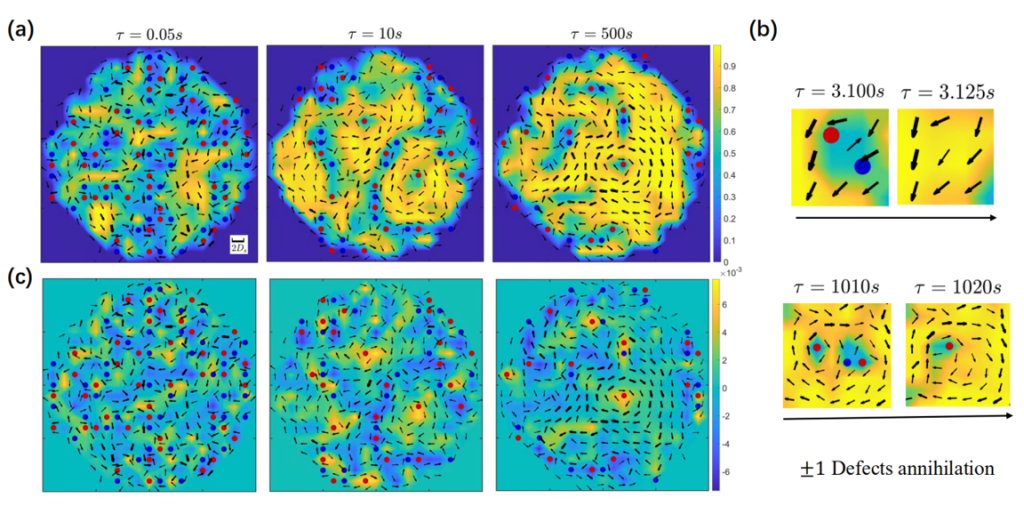
The study shows that topological defects in the system govern the steady-state, large-scale collective dynamics and the turbulent-like inverse energy cascade. The system self-organizes into collective motion through the annihilation of topological defects and the formation of large-scale vortex structures, accompanied by the transfer of kinetic energy from small to large scales. In addition, the study finds that the system’s dynamics are jointly determined by single-particle activity and interparticle interactions, exhibiting a three-stage temporal evolution at sufficiently high packing fractions.
Conclusion
The study establishes a direct link between microscopic topological dynamics and emergent large-scale behaviors in active granular fluids. It also demonstrates how coherent collective motion can arise in a homogeneous ensemble of apolar active particles, offering new insight into the physics of collective dynamics in biological, synthetic, and robotic systems.
The research team members include doctoral students Zihan Zheng, Cunyuan Jiang, Dr. Yangrui Chen (Now a postdoc at the University of Minnesota), and Profs. Matteo Baggioli and Jie Zhang. The paper’s first author is PhD student Zihan Zheng, and the corresponding authors are Prof. Matteo Baggioli and Prof. Jie Zhang. This research was supported by the National Natural Science Foundation of China and the Innovation Program of the Shanghai Municipal Education Commission.