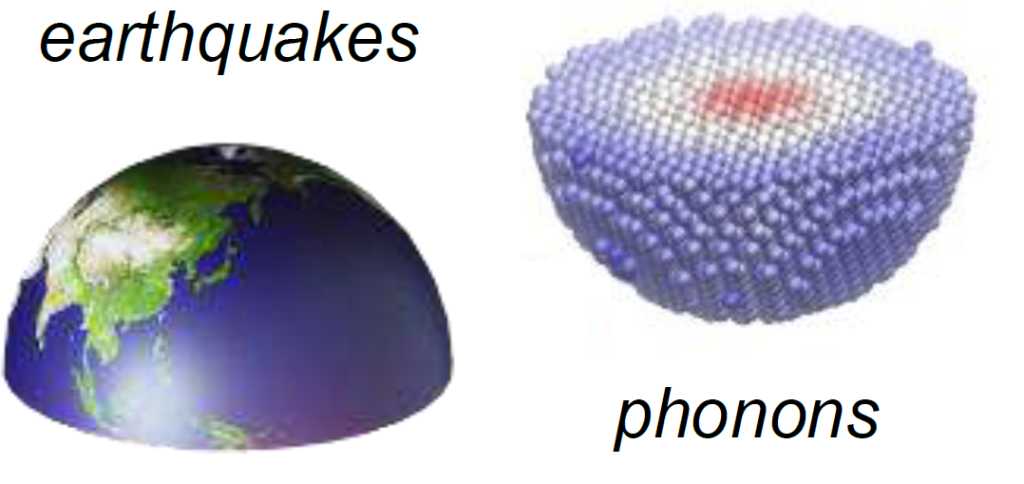
Every solid vibrates. In crystals, those vibrations are well understood. Glasses, however, hide an unexpected excess of low-energy vibrations that has puzzled scientists for more than half a century. This excess of low-energy vibrations, known as the boson peak, is one of the longest-standing mysteries in the physics of disordered materials. Despite decades of research, scientists still disagree about its microscopic origin.
Found in almost every type of glass—from ordinary window glass to polymers, metallic glasses and even granular materials—the boson peak influences how these materials store and transport energy. As such, understanding its origin has become one of the central challenges in the physics of disordered materials. Over the years, numerous—and often contrasting—theories have been proposed, yet no single explanation has gained universal acceptance.
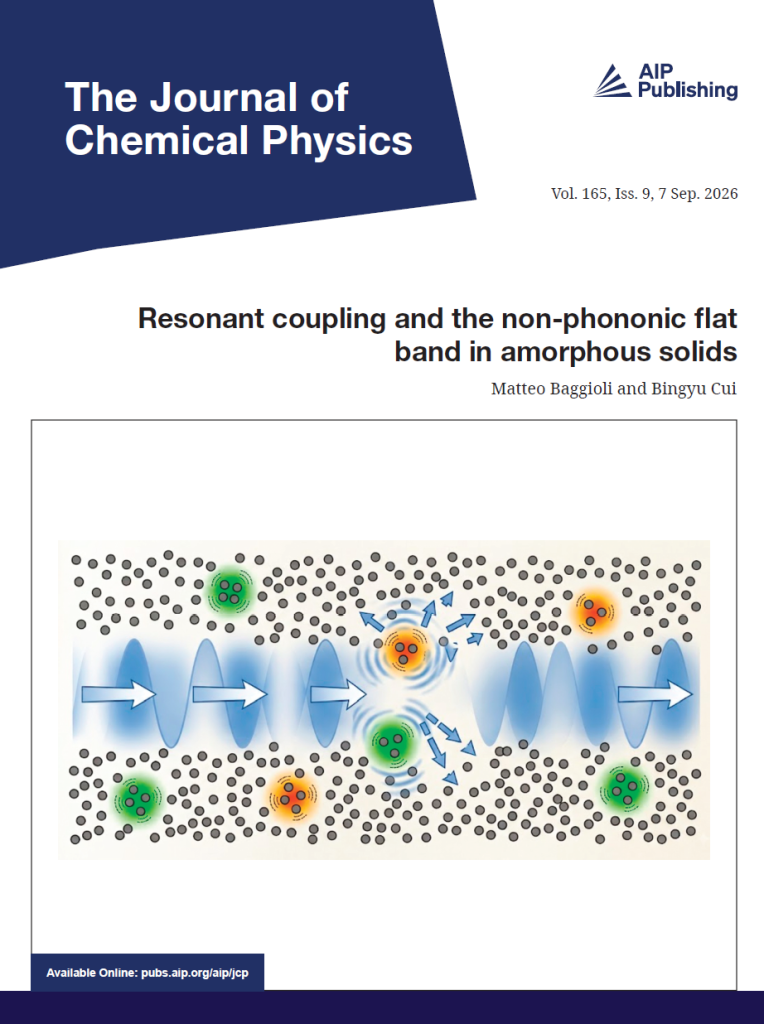
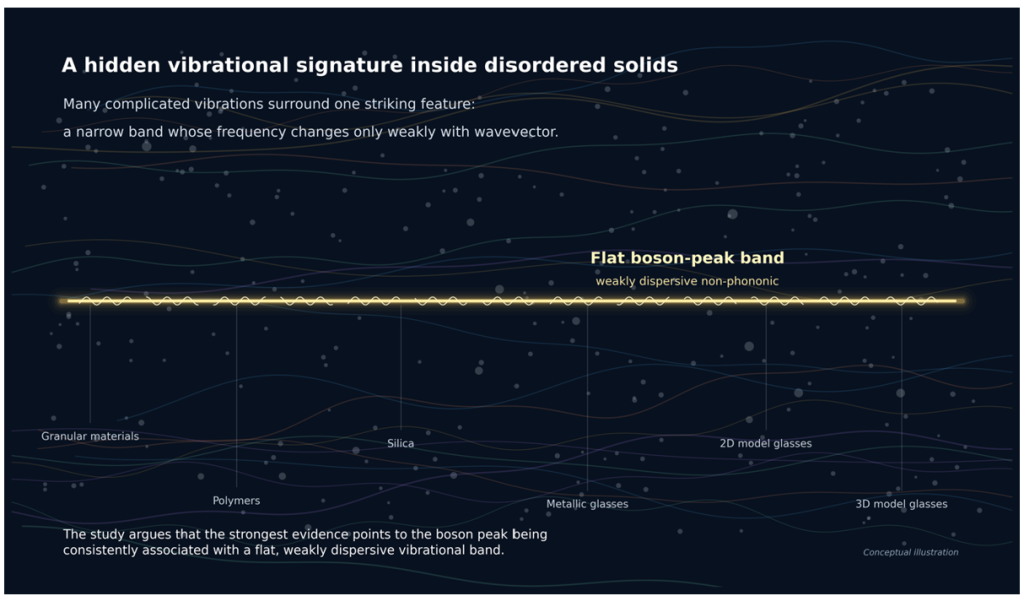
A new study brings together evidence from published experiments, the scientific literature and new large-scale computer simulations to argue that the strongest evidence yet points to a common picture: the boson peak is consistently associated with a flat, weakly dispersive vibrational band.
Unlike ordinary sound waves, whose frequency changes with wavelength, this band remains at nearly the same frequency over a broad range of length scales. Instead of propagating like a conventional sound wave, the vibrational spectral weight associated with the boson peak accumulates within a narrow frequency window.
Conceptual illustration of the proposed flat-band perspective. Evidence from experiments and simulations suggests that the boson peak is consistently associated with the accumulation of vibrational spectral weight into a flat, weakly dispersive band.
The researchers reached this conclusion by revisiting experimental observations reported across many different materials and combining them with new simulations of two- and three-dimensional model glasses, as well as new analyses of experimental data from two-dimensional granular packings. Across these remarkably diverse systems, the same vibrational signature emerged again and again.
These findings also provide a powerful new way to evaluate the many competing theories proposed over the past five decades. Some explanations interpret the boson peak primarily as a consequence of ordinary sound waves that become modified, scattered or strongly damped by structural disorder. Others propose that glasses support additional collective vibrational excitations beyond conventional acoustic phonons.
The observed flat, weakly dispersive band is difficult to reconcile naturally the with explanations based solely on modified acoustic phonons, whereas theories that include additional vibrational excitations remain, in principle, compatible with the full set of observations. More broadly, the study establishes a clear benchmark against which future theories can be tested. A successful microscopic description should explain why this weakly dispersive band emerges, why it coincides with the excess vibrational states that define the boson peak, and why its intensity follows the underlying structure of the material. No existing theoretical framework currently explains all of these observations in its present form.
The study also finds that the flat-band signal is predominantly associated with transverse, or sideways, vibrations, although important exceptions such as silica remain to be understood. This raises new questions about the microscopic origin of the band and whether it represents a universal feature of disordered solids.
By significantly narrowing the range of viable theoretical explanations, the work provides a clearer roadmap for future research. After decades of competing ideas, the study provides clearer picture of the key observations that any successful theory of the boson peak must ultimately explain.
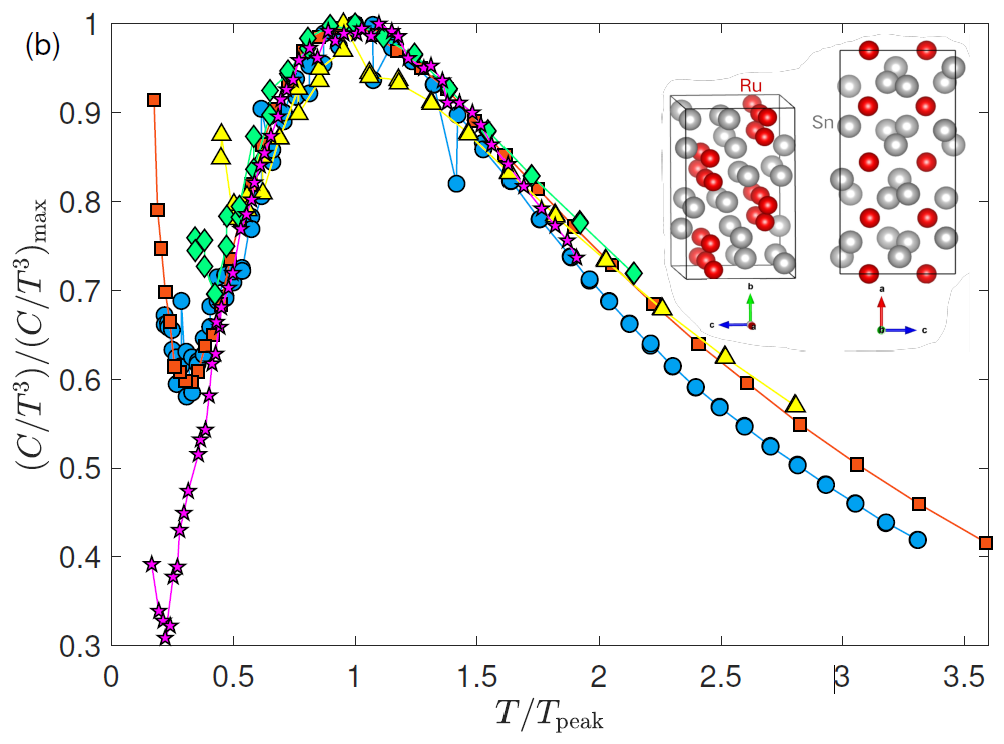
The separation between crystals and glasses is often more complex than what presented in the idealized textbook paradigms. Here, we reveal that chimney ladder crystals are more glassy than expected…
Can you guess which curves correspond to crystals and which ones to glasses?
The TheoryLab group at Shanghai Jiao Tong University invites applications for postdoctoral positions, with an expected start date of September 1, 2026.
Shanghai Jiao Tong University is one of China’s leading research institutions, with a strong international profile and a rapidly growing physics department. The School of Physics and Astronomy offers a dynamic and interdisciplinary research environment, with active interactions across condensed matter, high-energy physics, and complex systems, as well as strong international collaborations.
Research Areas
We are seeking outstanding candidates in:
Theoretical high-energy physics
Condensed matter theory
Soft matter theory
Statistical physics
Experience in one or more of the following areas is especially desirable:
Holography (gauge/gravity duality)
Amorphous systems (glasses, liquids)
Active matter
Effective field theories
Hydrodynamics
Ongoing collaborations with experimental groups provide opportunities to connect theoretical developments with real-world systems.
Appointment & Benefits
Initial term: 2 years
Possible extension: +1 year, based on performance and funding
Internationally competitive salary
Dedicated travel funding for conferences and collaborations
Opportunities to apply for national and municipal fellowships and grants, allowing for significant salary increases
Application Materials
Applicants should submit the following materials electronically:
Curriculum Vitae
List of publications
Research statement
Three letters of recommendation
📧 b.matteo@sjtu.edu.cn
Deadline
Applications will be reviewed on a rolling basis.
Priority will be given to applications received by May 15, 2025.
Recently, the Soft Matter and Active Matter Collaborative Research Group, led by Prof. Jie Zhang from the Institute of Natural Sciences and Prof. Matteo Baggioli from the Wilczek Quantum Center of Shanghai Jiao Tong University, has made significant progress in the study of collective dynamics in active matter. Focusing on isotropic active granular systems, the team systematically uncovered collective motion mechanisms in apolar active granular fluids accompanied by topological defects, and for the first time observed turbulent-like inverse energy cascades in this class of systems. These findings provide a new physical picture of how microscopic topological processes drive macroscopic collective behaviors in nonequilibrium active matter.
Active matter refers to a broad class of non-equilibrium systems where energy is continuously injected at the level of individual “particles”. These systems exhibit emergent collective behaviors that have no direct thermal-equilibrium counterpart. Their scale ranges from micrometer-sized swarms of bacteria to meter-scale human crowds. Being far from thermal equilibrium, active matter displays numerous novel physical behaviors not found in traditional equilibrium systems.
Recently, topological defects have become key to describing and controlling polar and active nematic systems. However, in apolar active systems—where particles lack both a preferred direction of motion and an intrinsic orientational axis—it remains unclear whether their collective behavior can be described using a topological framework.
Methods and results
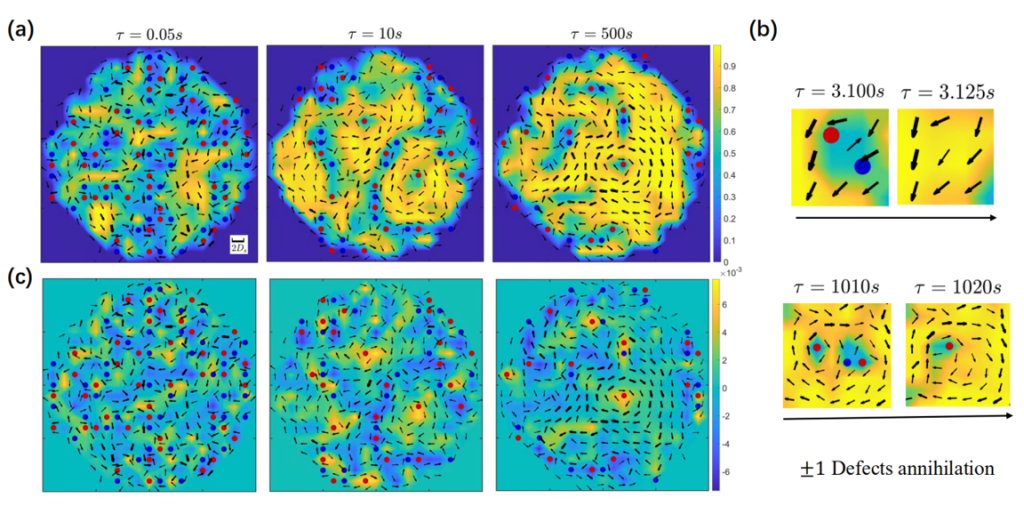
In this study, the research team designed and fabricated a bidisperse apolar active granular system using 3D printing technology. Under the driving of a vertical shaker, the velocity distribution of individual particles is centered around zero, and velocity correlations decay rapidly, indicating that the system lacks an intrinsic preferred direction of motion and that individual particle motion exhibits almost no memory effects. Using high-precision image processing and particle tracking techniques, the team was able to obtain detailed structural and dynamical information of the particle system.
The study shows that topological defects in the system govern the steady-state, large-scale collective dynamics and the turbulent-like inverse energy cascade. The system self-organizes into collective motion through the annihilation of topological defects and the formation of large-scale vortex structures, accompanied by the transfer of kinetic energy from small to large scales. In addition, the study finds that the system’s dynamics are jointly determined by single-particle activity and interparticle interactions, exhibiting a three-stage temporal evolution at sufficiently high packing fractions.
Conclusion
The study establishes a direct link between microscopic topological dynamics and emergent large-scale behaviors in active granular fluids. It also demonstrates how coherent collective motion can arise in a homogeneous ensemble of apolar active particles, offering new insight into the physics of collective dynamics in biological, synthetic, and robotic systems.
The research team members include doctoral students Zihan Zheng, Cunyuan Jiang, Dr. Yangrui Chen (Now a postdoc at the University of Minnesota), and Profs. Matteo Baggioli and Jie Zhang. The paper’s first author is PhD student Zihan Zheng, and the corresponding authors are Prof. Matteo Baggioli and Prof. Jie Zhang. This research was supported by the National Natural Science Foundation of China and the Innovation Program of the Shanghai Municipal Education Commission.
Universal corrections to the Kibble-Zurek scaling law across imperfect critical points
Continuous phase transitions are ubiquitous in nature and are marked by the appearance of critical points separating distinct phases of matter. Near these points, the dynamics are governed by the spontaneous breaking of a continuous symmetry, driving the system from a disordered to an ordered state. Remarkably, the physics in the vicinity of a critical point is largely universal: a small set of numbers—the critical exponents—controls almost all relevant behavior near the transition.
This universality extends beyond equilibrium. It also governs out-of-equilibrium processes such as rapid parameter changes, commonly referred to as quenches, that drive a system across a critical point. As independently recognized by Kibble and Zurek, crossing a critical point at a finite rate inevitably leads to the formation of topological defects, whose density follows a universal scaling law determined by the quench rate and the same critical exponents. This phenomenon, known as the Kibble–Zurek mechanism, has been experimentally confirmed in a wide range of classical and quantum systems.
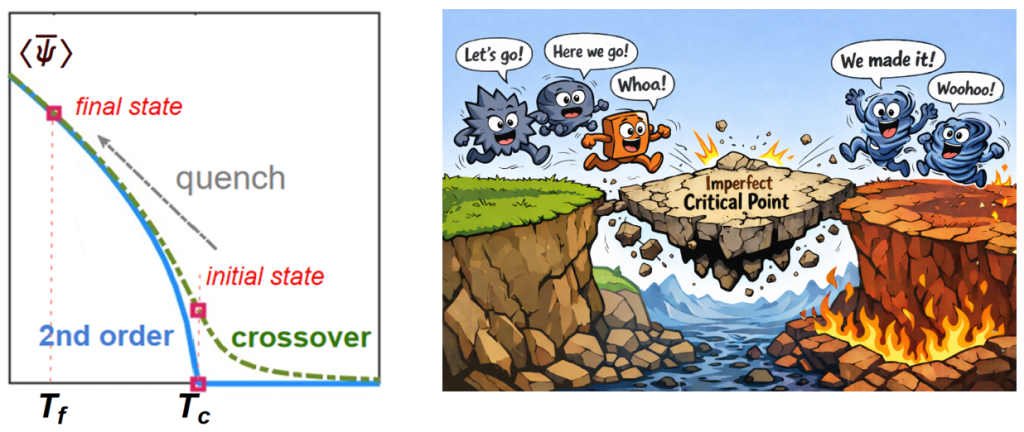
Figure 1: An external symmetry breaking parameter modifies a sharp 2nd order phase transition (blue line) into a smooth crossover or imperfect phase transition (green profile). The setup consists in quenching the system from an initial state near the original critical point (T=Tc) deep into the ordered phase (T=Tf). The right cartoon highlights the creation of topological defects (vortices) by jumping across this imperfect critical point.
Despite the success of this paradigm, many phase transitions and critical points in nature are imperfect. In these cases, the symmetry that would be spontaneously broken at criticality is already only approximate. Well-known examples include chiral symmetry in QCD and charge-density-wave transitions in metals with impurities.
What happens, then, when a system is driven across such an imperfect critical point, as illustrated in Fig. 1? How does the number of defects formed depend on the quench rate? And, crucially, do the Kibble–Zurek predictions survive, or do they break down?
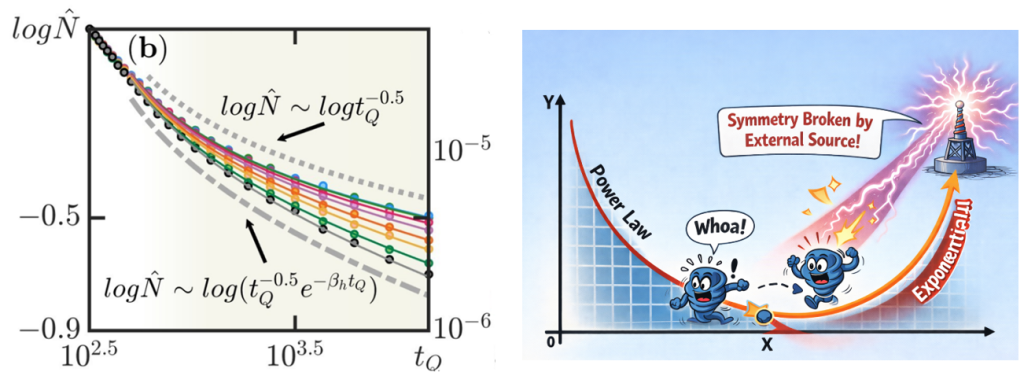
In a recent publication, a team led by Matteo Baggioli (SJTU Shanghai), in collaboration with Hua Bi Zheng (Hainan University), Sebastian Grieninger (Stony Brook), Chaun-Yin Xia (Hainan University), and Peng Yang (SJTU Shanghai), demonstrated the emergence of a universal exponential correction to the Kibble–Zurek scaling law (see Fig. 2). This correction arises when the transition is a crossover associated with an approximate symmetry, rather than a perfect critical point. This universal form has been demonstrated using both weakly-coupled models (Ginzburg Landau formalism) but also strongly coupled modes constructed using the holographic duality.
Figure 2. The universal exponential correction discovered by Baggioli, Yang and collaborators. The number of topological defects created during the quench does not follow anymore the Kibble Zurek universal scaling law but presents a new exponential correction that depends universally on the external field breaking explicitly the symmetry.
This discovery reveals that the universal physics of critical points and phase transitions can persist even in the presence of imperfections or explicit symmetry-breaking terms. The newly identified correction is expected to be observable in future experiments and to arise in a wide range of physical systems.
What Really Stops Fluids from Flowing? The atomistic mechanisms behind fluid viscosity
A visual representation of viscosity and its atomistic origin
We’ve all seen it in our kitchens: honey creeps down a spoon in slow motion, while milk pours freely from a jug. The secret behind this difference is something physicists call viscosity, a fancy word for how much a fluid resists flowing. Thick, sticky liquids like honey have high viscosity because their molecules rub and snag against each other, while runny liquids like water or milk slip past with ease.
Viscosity isn’t just about breakfast ingredients, it matters for how lava flows, how engines are lubricated, and even how glass is made. Yet, despite being everywhere, scientists still don’t fully know what’s happening deep down at the atomic level. What tiny molecular motions create this internal “friction”? And can we predict how viscous a liquid will be just by looking at how its atoms jiggle around?
These deceptively simple questions have puzzled researchers for more than a century, and they’re still chasing the answer today.
In a recent Nature Communications article, Matteo Baggioli (Shanghai Jiao Tong University) together with Yan Feng (Soochow University, Suzhou), Dong Huang (Soochow University, Suzhou), Shaoyu Lu (Soochow University, Suzhou), and Chen Liang (Soochow University, Suzhou), unveiled the atomic-scale dynamics that underpin viscosity in two-dimensional fluids. Building on the idea that viscosity is tied to the average time an atom loses or gains a neighbor, the authors derived a simple analytical formula expressed solely in terms of microscopic quantities.
Remarkably, this prediction matches simulation results across three distinct systems with different interatomic potentials. The derived expression establishes a direct bridge between macroscopic flow at large scales and the microscopic dynamics of individual atoms. It also offers a precise definition of the characteristic timescale for atomic rearrangements in liquids, thus identifying the length scale below which liquids retain elastic behavior.
In essence, this study reveals how friction in fluids emerges from atomic motion, shedding light on fundamental mechanisms while opening a pathway for predictive modeling and potential control of viscosity.
This study reveals that viscosity is governed at the microscopic level by the atomic mechanism of losing or gaining neighbors